Saturday, May 2, 2009

A Pacific Typhoon


Because I can't say anything more about the fight than these pictures do.

If you're looking for analysis of the beautifully phrased, putting-this-into-context sort, the type of post I wish I could write about boxing, head over to Boxiana (on the "sites we're following" box to the right) and check out this latest post, Tell it to the Judge. It's excellent work.

Baseball commentary to resume tomorrow, this fight ended up eclipsing the entire weekend of sport for me and pushing other things out of my brain.


Wednesday, April 29, 2009

Don't Look at My Finger, Look at the Moon


When I was younger I was not a fan of Michael Jordan. Back then I didn't really appreciate basketball the way I do now, the otherworldly athleticism and talent and dedication and beauty that comprises the pro game. There was more to it than that, though, because when I did focus on the NBA, I disliked Jordan, actively and routinely. Bear in mind too that this was when the Jordan/Bulls crested as a player and a team, during the mid-late nineties, so in all truth there were only infinitesimally small flaws to find. Even granted all that, though, I hated Jordan and never liked watching him play; hated his little dainty hand poses and first-step travels and anything else I could critique. I wasn't alone, either, and I can remember Rick Reilly penning an especially hateful column lambasting Jordan and the Bulls and Chicago fans (though for the life of me I can't find it online), and finding still more people who agreed with me, especially if their replica jerseys weren't red and black.

That's a pretty common thing, the pinnacle of one sport being hated by their rivals. But there's something corollary to that I've noticed and wanted to talk about: the indifference by modern media to that peak. And I mean this point very esoterically, because all my evidence is anecdotal and I'm sure a google search will clarify that the numbers skew even. So here goes:

It seems to me that most of our attention is devoted to players who have potential to be great, or who are on the descending side of their mountain. Meaning the periods of time where that player is among the all-time elite, where that player is doing things no one ever has, no one's interested in talking about them. It's (the ascent and decline) easy to talk about, I know. It's also more interesting to speculate than it is to give slightly differing opinions on what's already happened. Those two guys over in that bar probably have seen the exact same footage as each other, but one will tell you Ali was the greatest to ever dance in the squared circle, and the other will yell about how Frazier essentially went 3-0 against old Clay. It's the sort of opinion that gets compared to assholes. What-Ifs, though, are different. You get to imagine what would have happened if Wade and Caron shared the same backcourt, if Simms were drafted to the Niners instead of Montana, if Gibson played integrated ball, if Babe stayed a Sox. That's fun. Those two guys will bleed your ear with the numbers Williams would have put up if he never went to war.


I want to pay more attention to those few moments that really matter than I do hoping more monents will come. Because it's really easy to come back and punch up the numbers and go "yep, turns out there was never a better 4 than Tim Duncan," or, "finally, Federer lost the top ranking." That shit's easy. What's harder to do is appreciate greatness in its own time.

This, of course, is in no way specific to sports. Rolling Stone hated Led Zeppelin, and so forth. Perhaps there's a general laziness w/r/t intertia in the casual fan or sportswriter; show me the all-time numbers and we'll talk, or no one will listen to this crap, in another way of speaking. Or we just get to fetishize stuff we loved as younger version of ourselves, attaching with solemnity our allegiances to players and focusing our fandom with them at its center, thus hazing the next generation with impossible-to-top standards. I'll be the first to realize I grew up watching Griffey and defend him to this day as a top 10 all-time player so vociferously that it's clear my childhood passions are inflamed, rather than a rational sports conversation. But that hasn't stopped me from finding new players and recognizing genius when it steps on the field. Nor, I posit, should it hold back any of you.

What prompted this essay was a recent tweet by the FreeDarko guys about how they love watching Rondo play. And it occurred to me that recently I have read many pieces about Rondo, and his uniqueness and effectiveness over the last year and these playoffs. I am not doubting for a moment that Rondo is a baller, because he is. He's a player. But he's no Dwyane Wade. Not even for a second. And this season, while leading the league in points and averaging more assists than LeBron and having more blocks than anyone his height EVER HAS, Wade's been playing at what we have to assume are the physical limits of a basketball player/human being. Yet, outside of a mid-season SI piece, I haven't seen anything lauding Wade with the type of ridiculousness he's deserved; that praise has been handed to those douchey USC linebackers. Maybe that's a football-saturation problem, though the draft is a big deal in basketball, too.

We're all anxious to see what will happen.


So here's the real problem - we don't see what we've been waiting for when it happens because we're so consumed with what's about to happen. Put another way: Rondo maybe in 5 years develops the type of complete game that Wade has right at this very moment. Sanchez will probably never make that Pro-Bowl Peyton puts on his calendar every year. Or if we do come around to recognizing players, it's SI's mostly fawning piece on the Kid or the soon-to-be-written Tim Duncan appreciation posts that remind us how excellent he was. That's not good enough.

This hasn't been too focused on baseball, I know. It's almost harder than the other big two, because baseball's draft is small and the path tends longer to the MLB than the other two (or at least the process is quieter), and also in no small part because of the numerology that the words "All Time" creates. You can't just say in any serious baseball circle that you think Griffey is one of the all time greats, because his career average is hovering around .280 and his power numbers dropped and etc. But there was a year in 1996 when Junior played baseball as well as anyone in the history of the sport ever has. And I'm glad I was paying attention.

What shifted the waters for me most memorably was this benchmark NY Times article David Foster Wallace wrote about Roger Federer. It's a magnificent dissection of a world class talent at the absolute height of his game, and for me it was important enough so that I not only have been a fan of Roger's since, I have also now been casually following tennis - a sport I never watched even once - for the same period of time. It's a tribute to the late DFW's genius, to be sure, but it's also a compliment to Federer. When a player at that level bores the media with his dominance, then maybe, just maybe, we ought to demand more from our media. Or from ourselves as fans.

It's one thing to accept, however grudgingly, that player X on the other team is good. What this is about, and what I've been trying to say is that it's a far, far better thing to really appreciate that game for what it is. To not give a damn that you're born and raised in Chicago when you watch Pujols in those rectangular boxes, because sweet god he's one of the best to ever swing a bat.

That's part of the core of what JnM is about: We're for the breaking of false allegiances for the forging of worthy ones - stop rooting for the Rockies because you were born in Grand Junction, you should root for the Giants because... well, bad example. Root for a team because you like watching them play, you have a few favorite players with a shared jersey. Don't ignore Adrian Peterson because you wear cheese to football games. Don't dismiss King Felix because you're not from the pacific northwest.

These flashes of physical genius don't sustain themselves for very long, so let's make sure we're looking at the right thing.


Monday, April 27, 2009

The Right One In


In 90 feet, Jacoby Ellsbury made the entire week of baseball a footnote. A week that found Pujols hitting so well that superlatives have become as effective as a broken condom when trying to describe him. LaRussa looks worn out just trying to compare him to great hitters, it's like being in the company of such Greatness is exhausting. We're still early enough in the season where things like the Blue Jays and the Mariners at the top of their divisions aren't worth noting or focusing on, where the Natinals' abysmalness isn't yet historical. Besides, all evidence tells us that the Marlins will win it all this year, anyway.

Back to Ellsbury: It's not the first time someone has stolen home, hell, Pettitte had the same thing happen to him two years ago in Toronto. But this felt bigger. This feels important, in the way that the indefinable and subtle shifts of momentum and capital-D Dynasties are known to have occured. Because we know the Yankees will probably lose the division and maybe miss the playoffs again and they don't have a cohesive team and Teixeira looks vaguely inbred and so on and so forth. This three game set in Boston showed us how truly bad they are compared to a high standard. The Indians humiliated them in their new house, but the Sox took the floor right out from under them; those brooms waving in Fenway portend something awful if you're a Yanks fan. And when the player taking that floor away is Jacoby Ellsbury... let me just say that this is the type of play that in 15 years could lead off the Ellsbury appreciation clip packages on ESPN after a long and storied career.

What I have been thinking about watching the Yanks-Sox series is the nature of fandom. In the WBC, Pedroia and Jeter spent time together and exchanged through the media the sort of "He's a good guy!" inanities you'd expect. Now this isn't noteworthy in any major sports; basketball's All Star weekend ends up a circle jerk of love amongst the games' elite. In any walk of life, the two dozen or so greatest talents in any field are probably so alike in so many ways that when the veneer of competition is off they got along swimmingly. Of course, various grumblings were heard in Yankee and Red Sox fanbases, the usual "They should HATE EACH OTHER!" complaints. So what I wonder is: from the players' perspective, what does that Rivalry mean? As fans, we get to pick our side and affix the versions of Love and Hate we use for sports to our respective team and really invest ourselves in the outcome. It's very easy. But if you're a millionaire athlete; if you're Damon, if you're Lowell, what makes these games special? This isn't basketball, where a Wade can trascend teams and impose his dominance, there is a reliance in baseball on ones' teammates that only soccer comes closest to paralleling. (Football and Hockey both technically qualify, but the former has half the team sitting for half the game and the latter is more a niche sport than anything) And the only thing I can come up with is the pressure. The type of "playoff atmosphere" stuff you always hear about when the crowds are really into it, pushing their team to win.


Basically, it seems to me that the reason that rivalries like this are so intense, so hard fought and so enduring is that the fans will that into existence. Players can find enemies on the field, and undoubtedly some squads will come to dislike others over the course of seasons, but that's the flip side to a passing fancy, lost quickly and certainly not sustained over generations. It doesn't matter, really, what the players think of one another. It matters that the fans demand the other team's blood.

Sunday, April 19, 2009

Supplemental Fiber

A few quick site notes here: I am resolved to update more often. This regularity will hopefully help with reading as well as with commentary on current baseball events our longer player-specific essays lack.

So after this week, look forward to: regular posts on Monday and Thursday mornings. Our longer efforts, essays, esoteric ruminations and articles from sources not myself will come less often and will be put up on Tuesday or Wednesday. Maybe a bi/tri-monthly schedule for those.

Comments, suggestions and the like are always appreciated, either through the email link on my name or through the comment button button below each post. Thanks for your support!


Friday, April 17, 2009

Sorry Tom Hanks -- Sometimes There IS Crying in Baseball

Another Tigers-related post from our foreign correspondent and resident nickname expert, Blylevin's Beard, on the recent passing of Mark Fidrych:

When I conjured up Mark Fidrych in my recent Reboarding the D-Train post, it was mostly in the context of his inability to fulfill the hopes of Tiger fans who anxiously awaited his fantastic comeback in the 1978, 1979 and 1980 seasons. With the news of The Bird's passing, however, my hope is that we can all focus on the fact that for one absolutely brilliant season, every single time he took the mound, fans were glued to their TV sets, perched on the edge of their bleacher seats, rubbing their palms together in anticipation of what combination of weirdness and wizardry he'd bring to the ballpark that day. That's what Joy in Mudville is all about - celebrating the game of baseball, moment by moment, pitch by pitch, inning by inning. The Bird always seemed thrilled with his single season in the sun much moreso than he was disappointed in the frustrations that followed it, and I hope we can follow his lead, accentuating the positive as we reflect on his life and career. May one of baseball's great players and most original personalities Rest in Peace.

Wednesday, April 15, 2009

No. 42 and the Philosophy of History

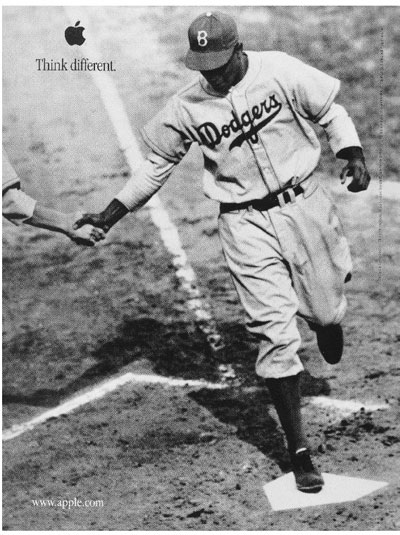
Today baseball celebrates Jackie Robinson day, which, not surprisingly, commemorates the day its namesake first took the major league field sixty-two years ago, thereby integrating the game and delivering upon the promise of athletic democracy that so many fans antecedently believed the game was imbued with. Robinson, as it is well documented, rather quickly became an icon on and off the diamond, and today, all number-wearing player personnel will honor him by adapting the sacred 42.

Now, there are a number of compelling vectors flying around and through the Robinson Narrative, from the banalities of personal biography to the upper reaches of cultural grandeur: a 28-year-old rookie leads his team to the World Series; Brooklyn general manager Branch Rickey's profit-driven (but still wholly admirable) insistence on integration to the newly installed commissioner Happy Chandler after the death of avowed racist Kenesaw Landis; baseball's new potential for expanded commercialization; and Robinson's play that day as a harbinger for--to paraphrase a zeitgeist-y refrain--Rosa to sit, Martin to walk, and Barack to run.

We have neither the time nor the inclination to give these themes their due, but it does seem all the more important to situate Robinson's color-barrier-breaking heroism so that his game, season, and career accomplishments are not swallowed up by the lofty rhetoric of today's well-meaning but ultimately hollow tributes. This situating involves slaughtering one of baseball's sacred cows (1) in order to properly rebuild another (2): (1) the infallibility of raw statistics as a measure of performance; and (2) Robinson's mythological status as courageous, decent, estimable, and a pretty good ballplayer, too.

I don't mean to suggest that statistics should be stripped of their status as baseball's dominant gene for historical documentation and future predictions; I intend nothing of the sort. Rather, I suggest simply that Robinson's unique situation warrants a unique analysis. And that, OF COURSE, brings us to Leo Strauss.

Strauss is primarily (though incorrectly) known in the public consciousness as the grandfather of a certain brand of neoconservatism that the Bush administration used to justify invading other countries. Sorry folks, but Strauss can't be scapegoated for that; he'll never be that influential. In actuality, he was an historian of political philosophy, an élite who relished the cloistered security of the ivory tower and harbored quite a fancying for some of the Ancients. Against the Cerberus of positivism, historicism, and relativism, Strauss believed that the answers to universal philosophical questions (What is the good life? What is the best political regime? etc.) are themselves universal, and that True philosophy is not bound up with the particulars of an historical period. So when Plato makes a normative claim about, say, the organization of society, Strauss believes it retains relevance and resonance in our time; he famously said that all one needs to grasp a philosopher's ideas is a text on an otherwise empty desk. Engage the thinker on his own terms, Strauss said, in order to get to the Truth. 

Why the apparent digression? I hope it's clear how the enterprise of "baseball statistics" operates under a Straussian rubric. Raw numbers are the archetypal form of timeless, universal performance measurement, enabling intergenerational comparison and cutting-edge figures for the future. Strauss looks at Bonds's 2004 OPS of 1.422 and sees a season "for the ages," not one to be contextualized in any way. He sees in Gorgeous George Sisler's 84-year record of 257 hits not a figure inflated by segregation and simplistic pitching practices but an eternal feat. Likewise, removed from all greater historical context, Strauss sees Jackie Robinson's rookie year batting average of .294 as good-not-great, his best season in 1949 as remarkable but perhaps not timeless, and his prompt election to baseball's Hall of Fame in 1962 as deserved yet still generous. 

Strauss might be right about Bonds and Sisler, but he's wrong about Jack, whose singular career is more about context than any other in the history of the game. Isolating Robinson's numbers from the social and cultural climate in which they occurred not only impoverishes his accomplishments, it fails to help fans understand what he went through for that .294 average, and how the combination of historical context and unhistorical (or anti-historical) number-mongering paint the fullest possible portrait. 

The British historian Quentin Skinner agrees with Strauss that the point of studying classic texts is because they contain timeless elements and universal ideas, but he believes it is impossible to do so without slipping into anachronism and parochialism. Instead of isolating texts from their moment in history, Skinner seeks to recover the complex intentions of the author by pouring through archives to discern everything possible: what words meant, prevailing conventions, the writer's mental state, everything. What Plato says is not directly translatable to our current situation, in Skinner's methodology; a lot of contextualizing and clarifying must go into every word before we can reasonably expect to understand him. Skinner's model is more tedious, to be sure, but, at least in Jackie's case, more rewarding. 

According to Skinner, then, Robinson entering Ebbets that Tuesday in 1947 and going on to bat .294, swipe a league-leading 29 bases, and lead his previously lowly team to the brink of a championship while enduring threats of violence and despicable racism from fans, owners, and his own teammates is neither "great" nor "remarkable"; it is unfathomable. Nearly half of the '47 Dodgers were Southern whites, and Dixie Walker, Eddie Stanky, and Bobby Bragan actually drew up a petition to Rickey saying they would rather be traded than play with a black teammate. Robinson's minor league manager in Montreal, Clay Hopper, didn't think that blacks were human beings. Rogers Hornsby and Bob Feller were both sure that Robinson would fail. In the face of unrelenting abuse, Robinson not only endured; he played with aplomb and passion, and he excelled. Hornsby and Feller were tremendous players but I wonder if they would've had similar career trajectories if their peers and fans thought they were sub-human and wished them to fail.  

I doubt it. But Robinson was different. He didn't just bat .342 with 124 RBI and 37 SB in 1949, earning MVP honors; he reached those numbers in the face of tremendous adversity, and not just the "passive" or "underlying" racism that is sure to be spoken of in stadiums today. The people he shared a dugout with thought he was less-than-human! He heard racial epithets, saw racist gestures, withstood racial incidences; he generally had to fear for his life...and he hit .342?? If Strauss doesn't believe context is important, then I'm choosing Skinner to be my resident historian/baseball analyst. And I'm choosing Jackie Robinson to play on my team.

Tuesday, April 14, 2009