Another Tigers-related post from our foreign correspondent and resident nickname expert, Blylevin's Beard, on the recent passing of Mark Fidrych:
Friday, April 17, 2009
Sorry Tom Hanks -- Sometimes There IS Crying in Baseball


Wednesday, April 15, 2009
No. 42 and the Philosophy of History
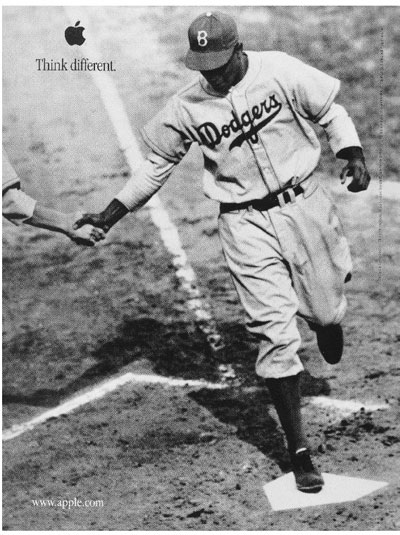
Today baseball celebrates Jackie Robinson day, which, not surprisingly, commemorates the day its namesake first took the major league field sixty-two years ago, thereby integrating the game and delivering upon the promise of athletic democracy that so many fans antecedently believed the game was imbued with. Robinson, as it is well documented, rather quickly became an icon on and off the diamond, and today, all number-wearing player personnel will honor him by adapting the sacred 42.


 According to Skinner, then, Robinson entering Ebbets that Tuesday in 1947 and going on to bat .294, swipe a league-leading 29 bases, and lead his previously lowly team to the brink of a championship while enduring threats of violence and despicable racism from fans, owners, and his own teammates is neither "great" nor "remarkable"; it is unfathomable. Nearly half of the '47 Dodgers were Southern whites, and Dixie Walker, Eddie Stanky, and Bobby Bragan actually drew up a petition to Rickey saying they would rather be traded than play with a black teammate. Robinson's minor league manager in Montreal, Clay Hopper, didn't think that blacks were human beings. Rogers Hornsby and Bob Feller were both sure that Robinson would fail. In the face of unrelenting abuse, Robinson not only endured; he played with aplomb and passion, and he excelled. Hornsby and Feller were tremendous players but I wonder if they would've had similar career trajectories if their peers and fans thought they were sub-human and wished them to fail.
Now, there are a number of compelling vectors flying around and through the Robinson Narrative, from the banalities of personal biography to the upper reaches of cultural grandeur: a 28-year-old rookie leads his team to the World Series; Brooklyn general manager Branch Rickey's profit-driven (but still wholly admirable) insistence on integration to the newly installed commissioner Happy Chandler after the death of avowed racist Kenesaw Landis; baseball's new potential for expanded commercialization; and Robinson's play that day as a harbinger for--to paraphrase a zeitgeist-y refrain--Rosa to sit, Martin to walk, and Barack to run.

We have neither the time nor the inclination to give these themes their due, but it does seem all the more important to situate Robinson's color-barrier-breaking heroism so that his game, season, and career accomplishments are not swallowed up by the lofty rhetoric of today's well-meaning but ultimately hollow tributes. This situating involves slaughtering one of baseball's sacred cows (1) in order to properly rebuild another (2): (1) the infallibility of raw statistics as a measure of performance; and (2) Robinson's mythological status as courageous, decent, estimable, and a pretty good ballplayer, too.
I don't mean to suggest that statistics should be stripped of their status as baseball's dominant gene for historical documentation and future predictions; I intend nothing of the sort. Rather, I suggest simply that Robinson's unique situation warrants a unique analysis. And that, OF COURSE, brings us to Leo Strauss.
Strauss is primarily (though incorrectly) known in the public consciousness as the grandfather of a certain brand of neoconservatism that the Bush administration used to justify invading other countries. Sorry folks, but Strauss can't be scapegoated for that; he'll never be that influential. In actuality, he was an historian of political philosophy, an élite who relished the cloistered security of the ivory tower and harbored quite a fancying for some of the Ancients. Against the Cerberus of positivism, historicism, and relativism, Strauss believed that the answers to universal philosophical questions (What is the good life? What is the best political regime? etc.) are themselves universal, and that True philosophy is not bound up with the particulars of an historical period. So when Plato makes a normative claim about, say, the organization of society, Strauss believes it retains relevance and resonance in our time; he famously said that all one needs to grasp a philosopher's ideas is a text on an otherwise empty desk. Engage the thinker on his own terms, Strauss said, in order to get to the Truth.

Why the apparent digression? I hope it's clear how the enterprise of "baseball statistics" operates under a Straussian rubric. Raw numbers are the archetypal form of timeless, universal performance measurement, enabling intergenerational comparison and cutting-edge figures for the future. Strauss looks at Bonds's 2004 OPS of 1.422 and sees a season "for the ages," not one to be contextualized in any way. He sees in Gorgeous George Sisler's 84-year record of 257 hits not a figure inflated by segregation and simplistic pitching practices but an eternal feat. Likewise, removed from all greater historical context, Strauss sees Jackie Robinson's rookie year batting average of .294 as good-not-great, his best season in 1949 as remarkable but perhaps not timeless, and his prompt election to baseball's Hall of Fame in 1962 as deserved yet still generous.
Strauss might be right about Bonds and Sisler, but he's wrong about Jack, whose singular career is more about context than any other in the history of the game. Isolating Robinson's numbers from the social and cultural climate in which they occurred not only impoverishes his accomplishments, it fails to help fans understand what he went through for that .294 average, and how the combination of historical context and unhistorical (or anti-historical) number-mongering paint the fullest possible portrait.
The British historian Quentin Skinner agrees with Strauss that the point of studying classic texts is because they contain timeless elements and universal ideas, but he believes it is impossible to do so without slipping into anachronism and parochialism. Instead of isolating texts from their moment in history, Skinner seeks to recover the complex intentions of the author by pouring through archives to discern everything possible: what words meant, prevailing conventions, the writer's mental state, everything. What Plato says is not directly translatable to our current situation, in Skinner's methodology; a lot of contextualizing and clarifying must go into every word before we can reasonably expect to understand him. Skinner's model is more tedious, to be sure, but, at least in Jackie's case, more rewarding.

I doubt it. But Robinson was different. He didn't just bat .342 with 124 RBI and 37 SB in 1949, earning MVP honors; he reached those numbers in the face of tremendous adversity, and not just the "passive" or "underlying" racism that is sure to be spoken of in stadiums today. The people he shared a dugout with thought he was less-than-human! He heard racial epithets, saw racist gestures, withstood racial incidences; he generally had to fear for his life...and he hit .342?? If Strauss doesn't believe context is important, then I'm choosing Skinner to be my resident historian/baseball analyst. And I'm choosing Jackie Robinson to play on my team.

Monday, April 13, 2009
Baseball Isn't About Feeling Good

At the beginning on the 2007 baseball season, after the Mets had won the NL East Division easily the prior year, Jimmy Rollins said this:

"The Mets had a chance to win the World Series last year. Last year is over. I think we are the team to beat in the NL East, finally. But, that's only on paper."
The Phillies then won the division by one game and Rollins was named the 2007 NL Most Valuable Player.
In 2008, Johan Santana signed with the Mets and their center-fielder Carlos Beltran, flush with the excitement landing a marquee Ace brings, said:
"So this year, to Jimmy Rollins, we are the team to beat."
Now, this is pretty tame stuff, I'll grant you. Baseball doesn't lend itself to the sort of grandiose predictions and boasts that football or basketball often do. It's the nature of the game; hitting the ball a third of time you bat is an excellent accomplishment and the season essentially lasts a half year, so getting all Namathy and guaranteeing a victory is both useless and antithetical in many ways. But what Rollins said in response while in spring training is the stuff of legend:
"There isn’t a team in the National League that’s better than us. The pressure’s back on them if you ask me. They were on paper the best team in the division last year and they were supposed to win, and they didn’t. One, there are four other teams in our division who are going to make sure that doesn't happen, and two, has anyone ever heard of plagiarism? That was pretty good, especially coming from him. He's a quiet guy, so it was probably shocking when he said it. Not shocking in a bad way, like 'Wow, I can't believe he said that.' More like, 'Wow, he finally said something because he's a leader on that team and you definitely need to be a vocal leader."
In one fell swoop he decimated Beltran - who is an excellent player - the Mets and the entire National league. That year, of course, the Phillies went ahead and won the World Series.
So the question I want to ask here is this: Why isn't Jimmy Rollins a bigger deal? Because he damn well should be.
Hell, earlier this year Davey Johnson, in a fit of what we'll call Larry Brown-type myopia, started what appears to be the corpse of Derek Jeter over Rollins at short.
Baseball, perhaps more than any other professional team sport, suffers from a surplus in terms of recognition. It's not just the huge rosters and the ever-changing lineups; football is essentially nine faceless men and a couple recognizable position players. It's also the fact of the teams themselves, at no point does there seem to be any focus on more than a couple for any reasonable period of time from the national sports media. For most of the decade, in fact, those teams have both been in the AL East. This sounds more unkind that I mean it, because I can't really blame the press for doing so- following baseball takes work. The kind of time that young kids and older men have in abundance, who memorize lineups and stats and take score at the game and things of that sort. Ask any baseball fan in his/her mid or late twenties or early thirties who the Cardinals have at left and they'll probably look back at you blankly. Some won't be able to name their team's starting nine. But you can bet your ass when they were 13 they knew that back and forth. Football is easier to watch, easier to follow, easier to field a fantasy team. All that means, at least as far as this essay goes, that no one is really getting stories on a team unless that team is the Yankees or the Red Sox.
And somehow the Phillies are essentially a small market squad. Last year's WS matchup with the Rays was basically murder to the MLB brass looking for ratings; no one on a national level cares about them. Cole Hammel, the handsome white pitcher, got a cover story on SI after they won, and Rollins did too in 2007 when he won that MVP we've discussed so much. You know who the last Philly on the cover of SI was? Not Howard. Think later. Think Steve Carlton, in 1983. Philly as a city is so obsessed with the Eagles that they themselves don't apparently care about their baseball team. Anecdotally, a friend of mine who was born and raised in Philadelphia evidenced this to me without even knowing. As the Phillies made their WS run, he was happy and casually supportive. When the Eagles lost to the Cardinals, he was almost put on suicide watch. (This could snowball to a rather unkind diatribe of the fans in Philly, and I won't do that. At least not now.)
Rollins, though, should be above this. As a baseball player, he's among the game's elite and for my money the best shortstop in the NL. He has all five tools (the most notable of which is his speed - he's transcendentally fast), plays the game beautifully and is maturing; winning Gold Glove awards while hitting more home runs, lowering strikeouts, moving the runner over more, taking walks, etc.. All that, though, takes a backseat to his personality, and I mean that in the best possible sense. Jimmy Rollins is funny. He's smart, he's quick in interviews, he's the sort of guy who can transmit in 5 second the type of creativity and humor that shows like The Best Damn... can't manage in a full hour; the type of person who has the laconic ebullience Kobe and Bron and countless other NBA players wish they had. He's the one player who you half-want to retire so you can watch him instead of Kruk on Baseball Tonight. That clip a few posts down from the Dick's Sporting Goods commercial is notable because his version of getting hit with a baseball from a pitching machine is substantially funnier than professional comedian Adam Sandler's.
Growing up in Oakland while the Athletics were at their most recent championship form, Rollins idolized Henderson. Now, Ricky has himself over the years become an industry of self-parody; he started referring to himself in the third person before anyone. He also played the game in a hubristic, flashy way that was worth watching even if you didn't like baseball: snapping the glove quickly from his side to catch pop-ups (and every now and again missing the ball while trying to be so cool), wearing retina-searingly bright batting gloves to run the bases, stealing with an intent and purpose that bordered on sinister, sliding headfirst every single time; Ricky was one of a kind. Rollins, to his eternal credit, shares with Ricky none of the self-aggrandizing nonsense or third person speech patterns, but has quietly taken a bit of style and flash for his own. He runs with a low center of gravity that suggest a running back and slides with the abandon of youth, he hits and fields with a dialed-down intensity and grace that calls to mind a very powerful engine running in a low gear. He plays the game Ricky would have played if Ricky didn't believe Ricky was the best baseball player in the world.
Rollins, I hope, will get his due. The type of player he is with the type of personality he has doesn't come around often. I won't exhort you to watch him any chance you get - remember, following baseball is hard - but what I will say is: while Jimmy Rollins is around, we should be paying attention.

Tuesday, April 7, 2009

Thursday, April 2, 2009
Unshakable Faith

A certain member of our staff who tends to be more numbers-aware than I has posited, rightly so, that Big Al's numbers are in many ways face-meltingly incredible. I'll let him make his own argument, which will come here at some point this season, but I've been less than impressed with Pujols as a player than he. It's not for lack of remarkable moments; as the city of Houston can probably attest to. It's been hard for me to pin down what exactly it is I don't like about Albert, and my argument was mostly a hodgepodge of suspicion at his hitting prowess and physique, the lack of physical grace in the Maysian sense, and Pujol's own churlish comments at Howard's MVP award a few seasons back.
[Quick aside there: For background's sake, if you're unfamiliar, Pujols carried a pretty average Cardinals team to the WS in 2006, while at the same time finished second in MVP voting to the Phillies' Ryan Howard. The numbers sort of wash out, Pujols with a better average and Howard with better power - RBI and HRs - but Howard put up some gaudy digits towards the end of the season and was seemingly the only player in Philadelphia trying to win a baseball game, so in the end he won the award. The awards are largely subjective, and I don't want to step on the toes of an upcoming post about what the MVP award should mean, but it didn't then and doesn't now seem like that big of a deal. Especially considering that Pujols won the thing in 2005. And the fact that he got a ring should probably abate his pain, but he went ahead and decided to give his ridiculous opinion about the voting, which went:
"I see it this way. Someone who doesn't take their team to the playoffs, doesn't deserve to win the MVP."

(apologies for the easy picture)
Which came across as severely selfish and self-aggrandizing. It has actually gotten worse with age; seeing as how now Howard won his ring last season and Pujols was awarded MVP for a non-playoff eligible Cardinals squad; one would assume Pujols would turn down the trophy for philosophical reasons - unless he was simply being in a bitch. In any case, it didn't serve his reputation well.]
Which bring me to this recent Sports Illustrated cover piece on El Hombre, which I strongly encourage you to read. While not revelatory or even particularly interesting, it has swung me in a small measure to the side of fandom, for probably the opposite reasons that Mr. Posnanski wishs.
It's pat with the standard writery set pieces that in large part we hate about MSM sports coverage: kids with disabilities, straw arguments, very little actual baseball discussion, and so on. But what it reveals about Mr. Pujols is a consistent excellence that has had little conversation to this point (his thick/strong but not lean body style and almost flawless eye, combined with a swing that seems too perfect all land on the Bonds side of supplement-suspicion, as was his lack of fanfare coming up through the system [in the way Ellsbury or Sizemore were lauded], this piece explained how he's been a baseball prodigy since he started playing) and a religious devotion to baseball that has sapped him of all personality.

But maybe that's where his appeal lies. Duncan is, after all, one of my favorite basketball players, whose style exists as a negative (detailed here much more eloquently). While not a perfect parallel, I think Pujols might be the baseball version of Timmy D. It's exemplified best in his position; usually first base is where the lumbering power hitters sit and hope to not be made fools of; Fielder and Vaughn spring to mind, but Pujols has made the non-remarkable and workman position a bastion of his proficiency and is quietly the best fielder on his team. His swing, too, is the most praised part of his game and almost without peer, but it's less memorable and flashy than we expect, somehow. See: Manny.
The sort of non-sport specific things we normally glean from our premiere athletes - the various stylistic changes Jordan inspired, or the backwards hat and easy grace of Griffey; hell, even the simple adornments of Ripken - are lacking from Pujols. Here too, he is in Duncan's good company: wearing an absurdly ugly goatee and that huge necklace, Pujols further manages to mess up his baseball uniform in a way Duncan could never attempt, tucking his pants into his cleats. Pujols, to his credit, makes this endearing; and really it all means is that outside of his stance we can't see any kids trying to emulate his game.
But this isn't a bad thing. Pujols, playing in and to St. Louis, will probably never be the hottest baseball player on the planet.
All evidence points to him being the best.

Subscribe to:
Posts (Atom)